|
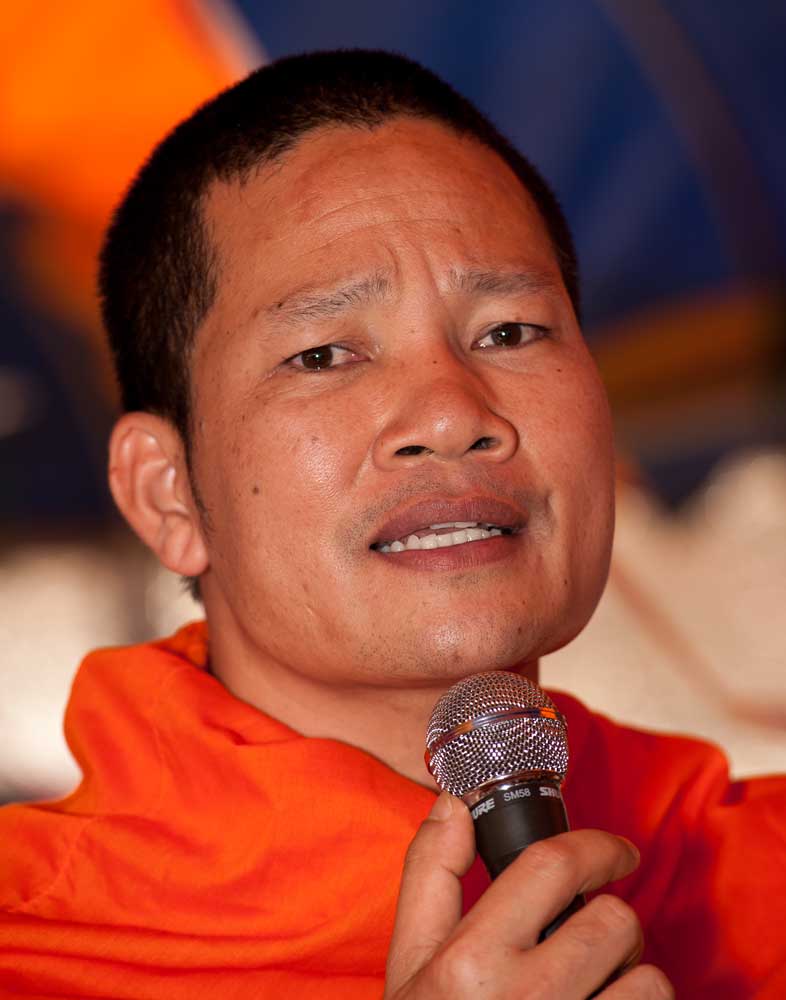
| Monk Singing His Role As A "Father" - At This Point A " Dead Father" In A Dream |
I have had the elements of this blog organized in my mind for almost a month now. The combination of a desire to complete editing and post processing all the photographs associated with this blog entry along with some inexplicable reticence to finalize the blog have delayed me until today.
Today, as it turns out, was worth waiting for. As you can tell from the title this blog entry is about singing Monks - Buddhist Monks. Most people are familiar with the chanting of many sects of Christian Monks. Back in the 1960's there was a famous "Singing Nun". On the cable news today there was story about an Italian Monk who has signed a recording contract. Buddhist Monks are renowned for their chanting. On the Internet you can find many videos and mp 3 recordings of Buddhist Monks chanting.
Buddhist Monks singing? I suspect that not many people are familiar with Buddhist Monks singing. If you research on the Internet you will undoubtedly quite easily find that Monks are not supposed to sing. Well there are many things that Buddhists as well as Buddhist Monks should or should not do. The practical application and inclusion of local customs and practices make defining Buddhist practices in short universal statements difficult. Think in terms of a house - the foundations of homes are basically the same. The functions of a house are the same. However there are many different appearing structures built upon a foundation to serve the function of a house.
I have written several times about rituals or elements of rituals that although they were performed by Buddhists and in some cases in which Buddhist Monks participated, they were not part of Buddhism. The tying of strings around the wrists of laypeople, the sprinkling of holy water on laypeople, the wearing of amulets, idols, talisman and use of fireworks are all vestiges of earlier animist and Hindu beliefs and practices to the local cultures which are Buddhist today. Buddhism is an an tremendously tolerant "religion" in that these practices are not condemned but assimilated and accepted into the Buddhist practice for they give the local people confidence and inspiration to continue along on their Buddhist path.
Last month we attended a special merit making event in Tahsang Village for some of my wife's relatives. The special merit making ritual is difficult to describe in a few words - it is essentially a big party to mark the death of a relative. The party is not to celebrate the death per se but it is an occasion to assist the spirit of the departed on its journey to its next life by making offerings to and for the spirit as well as the local Monks.
These events are quite common here in Isaan. Theoretically these events are held around one year after the person has died. But the reality is they are held when the family can financially afford to pay or finance them. For the event we attended last month, Duang's Aunt was holding the event for her husband who died 10 years ago and for her mother who died 20 years ago. Due to the cost of such events they are some times combined with another occasion which requires a big "celebration". In the case of Duang's Aunt last month, her son was also becoming a Monk. The event lasts all day and all night with it completing the next day.
We arrived in the morning to participate in the offering of food to the Monks and cutting of Duang's nephew's hair in preparation to becoming a Monk. In the early afternoon three throne like chairs were set up underneath the main canopy. These golden intricately carved wood chairs are used for Monks to sit cross legged upon while reading or lecturing the scriptures. However on that day, I learned that they are also used for another purpose - for Monks to sit in while they sing.
After the chairs had been set up, three Monks that I had never seen before arrived. These Monks brought their own microphones, amplifiers, mixing boards, and computers. They even had a young man to set it up for them. I knew that I was about to learn something new.
From Duang, I learned that these Monks were from another village and they go and put on a "show" for people. The "show" turned out to be a morality play - a play about life and Buddhist family values. One Monk played the part of a father. The second Monk played the part of a son. The third Monk, the youngest played the part of the mother. Most of the performance was song with dialogue providing transitions between the songs.
According to Duang we were witnessing "Nangmakao". A performance usually takes 4 hours. Due to the need to parade through the village as part of the Monk Ordination ritual later in the afternoon, this performance was cut down to three hours. It is a story about a mother, father, grown-up son, and grown-up daughter. The daughter is "no-good" in that she talks bad to her parents and does not take care of her parents. "Take care" involves financially, and materially supporting your parents. It runs the gamut from giving them money each month to cooking and cleaning as necessary to keep your parents well. In the Lao Loum culture the burden of this is the responsibility of the youngest daughter but expected of all the children. So in this story the daughter is especially bad - not respecting and taking care of her parents and not doing it as the youngest daughter. The son on the other hand is a good person. He takes care of his parents. The songs deal with what the daughter does not do and should do. The songs from each family member's perspective deals with their sadness and disappointment that the daughter does not have a "good heart".
 |
| A Monk. in the role of "Mother" Cries About Her Children |
As part of the morality play, the son dreams that his mother and father die. The spirits of his deceased parents want food and money for their journey to the next life but are not able to get them. The son, who was a good son but not a perfect son, is devastated at the loss of his parents. He laments the times that he did not respect them and the fights that he had with his father. The mother cries as she sings about all the times her children did not visit her and take care of her. The father is more angry in his singing and laments about how sad and how much the mother cries because of the children. Despite the son and daughter being wealthy, the father sings that they do not want to take care of their parents apparently telling them to go away like dogs in the street to get food This is definitely not nice in any culture - for sure!
The son wakes up from his dream and kind of reads the riot act to his sister about taking care of their parents. The daughter turns a new leaf and starts to pray to Buddha every day and takes care of her parents like she is supposed to do. The son also takes care of his parents and becomes an even better son.
The songs are sung in the style of traditional Mahlam Lao but without any musical accompaniment. The songs are sung with a great deal of warbling and tonal range. This link is one of the songs that the Monks sang but without the instrumental accompaniment.
http://youtu.be/OnoSvHUVHGo
As the Monks performed, laypeople would approach them, and place money offerings to the Monks in the cloth bag that hung from each golden throne. The Monks would then place "Saikaen" in the offering plate for the layperson. "Saikaen" are braided string bracelets over which the Monks have recited scriptures and chanted over. They are worn by people for good luck and fortune. They are dropped on an offering plate to ensure that Monks have no physical contact with women. For larger offerings to Monks or from a Monk, the object is first placed on a folded cloth which the recipient will then pull towards them to accept the offering.
 |
| Duang Accepts "Saikaen" From Singing Monk |
At the beginning of the performance, two trays of food and drink were placed on the raised platform where the Monks had been previously seated. The food and drink were offerings to the spirits of the deceased husband and deceased mother of Duang's aunt.
At the conclusion of the Nangmakao, a special merit making ritual was performed for the benefit of the two departed spirits. Laypeople burned Joss Sticks as the Monks chanted about the spirits going up rather than hanging around now that they have been given food, money, and the Monks have taken care them
 |
| Merit Making Ritual for the Departed Spirits. |
There was not a dry eye underneath the canopy - it was quite emotional and sad.
I earned some merit too, not necessarily in terms of the Buddhist religion, but with my in-laws when Duang noticed and pointed out to everyone that I was crying too as I was taking photographs.
It was a very moving experience. The youngest Monk, who played the role of the Mother, gave Duang his card. I told her that when I died I wanted them to do their singing for me but I was not planning on it being any time soon. I also had Duang tell him that if she died before me, I would become a Monk and he and I could go to all the villages to make people cry with our singing. We all had a good laugh.
 |
| Spirit Houses Constructed for Merit Making Ritual |
The next morning the spirit houses specially constructed for the departed people along with the money offerings, rice, sahts (woven reed mats), mons (pillows) and other offerings collected from the laypeople would be paraded through the village on their way to be presented to the local Monks on behalf of the departed spirits as well as donors.
Last weekend, we attended in Nongdaeng Village another ritual for the spirit of a departed relative. The most recent ritual was for the death of a mother 5 years ago. This event also included singing Monks but different ones than at the December ritual. This time there was also the full 4 hour version of the "Nangmakao". Once again it was a very interesting, and moving experience.
 |
| Monk Singing "Father" Role of Nangmakao in Nongdaeng Village |
Our grandson, Peelawat who will be 4 years old next month, seemed to enjoy the performance. He split up his time on my lap, as I took photographs, and on Duang's lap where she instructed him in worshiping He also got to eat ice cream and drink Coke so he was happy the entire four hours.
 |
| Peelawat learning to Chant In Pali |
 |
| A Monk Singing As Part of Merit Making Ritual |
 |
| Family Making Offerings to Spirit of Their Grandmother |
 |
| Food Offerings for the Spirit |
So although Monks are not supposed to sing, apparently the local custom in Isaan allows them to sing in order to instruct the Lao Loum laypeople the teachings of Buddha and to assist people to make merit for the departed.
This is the way that life is here in Isaan.
There is always something new to witness and learn even if you think that you have seen it all.
Things are not always the way they seem or as simple as they appear at first.
There are many levels of understanding and as you delve deeper into the details of the culture, the richer the world around you becomes and the fuller your life becomes.
There is no need for any of us to watch a "reality show", for real life is waiting for each one of us if we but open our eyes, ears, and mind.

 Posts
Posts