Here in Isaan, I have written of the rhythm of time marked by the cycle
of work in the fields surrounding my wife's home village, Baan Thasang
(Thasang Village). Time is also marked by the passage of life's
milestones within the extended Lao Loum family as well as within the
many small villages that dot the Korat Plateau of Northeast Thailand.
Last week, one of Duang’s Uncles died. He died at home like most of
the villagers in Isaan do when their time has arrived. He died at 75
years of age from liver cancer which is a medical condition
that many Lao Loum people suffer with. Isaan is the capital for liver cancer in Thailand.
Typically there is a
three day funeral ritual in the Lao Loum culture. The three day period
allows the family time to prepare for the cremation of the deceased. I
also suspect that the three day period also has connections and
connotations to Buddhism. In Buddhism the number, 3, is very special.
During rituals, people will bow their heads three times; and repeat
certain words three times. When making offerings people will burn three
joss (incense) sticks, and light three small yellow candles. When
people place gold leaf on statues, it is three squares of gold. "Three"
is significant in that it represents "Buddha", "The Teachings of
Buddha", and "The Buddhist Religious Community".
A vigil is maintained for the three days that the coffin is in place at
the home. Each evening at 6:00 P.M. of the first two days of the
ritual, Monks visit the home and chant.
During the first two days, family and friends are busy making
arrangements for the cremation on the third day. A field kitchen is set
up to prepare food for people who will be participating in the three
day ritual. Tables and plastic chairs are rented and set up. Canopies
are rented and set up to shelter people from the sun and the possibility
of rain. Drinking water, Lao whiskey, soft drinks need to be purchased
for each table for each day. Beef and pork are purchased and chopped
into a paste like consistency to make laap, a Lao Loum specialty dish.
Women are busy preparing papaya to make "Pauk Pauk" - spicy papaya
salad, a staple of Isaan cuisine.
Upon his death, his family
contacted the Monks of the village Wat who helped with the arrangements
for his funeral.
His family cleansed and tended to his body prior to laying him in repose
inside of his home.
On the day of a person's death, the family cleans the body and places it
in a disposable coffin. The disposable coffin, which will be consumed
in the cremation fire, is then placed inside of a rented refrigerated
coffin. Typically the refrigerated coffin is kept inside the home.
Offerings are placed on top of the coffin. Plastic
flowers, real flowers, and strings of blinking lights are strung along
the length of the coffin. On the floor in front of the coffin, a shrine is set up where people can make offerings, burn incense, and
light candles as they pay their respect to the deceased.
In front of the coffin as well as above it, special
memorial wreath like objects are placed. To the side of the coffin, a
large framed photograph of the deceased person is placed on an easel.
Next to the photograph, there is an area where donations of rice are
collected in the name of the deceased. People when they come to pay
their respects donate cash and/or rice to assist the family and to make
merit. The cash is used to help defray the costs of the funeral,
offered to the Monks as part of merit making ritual for the
deceased, and the rice is donated to the Monks who will provide it to
people who are unable to afford food from local markets.

He had been placed inside of a simple white coffin. On one of his wrists there were several strings of plain cotton
string similar to butcher’s string that were tied around her wrist
during a Bai Sii ceremony. The strings were tied around his wrist, in
the Animist belief, to bind the 32 spirits that are contained within
people and required to maintain good health. The Bai Sii ceremony is
also used to wish people good luck and prosperity.
In Isaan, many of the rituals and beliefs from
the Animist, Brahman and Hindu religions have been assimilated and
adopted into the Buddhist rituals. The deceased man’s hands were
placed into a wai (position similar to traditional Western praying
position) with a single yellow candle between his clasped hands, along with paper money, coins, and a sprig of floral buds. The
candle is about the size of a typical birthday cake candle is used as an
offering during merit making rituals. The men who handle the final preparation of the body just before the cremation, take the paper money. The coins which melt in the heat of the cremation furnace are retrieved from the ashes and bone fragments the next morning. The molten coin fragments are often placed in a small vial that is worn around the neck of a son.
The white coffin was placed
inside of an elaborately decorated refrigerated outer metal container
that is rented for the mourning period. The refrigerated container is
plugged into an electrical outlet in the main room of the home and
preserved the body for the next three days.
Outside of the home, several rented
canopies had been erected along side of the home and in the backyard.
Underneath two canopies in the front yard, tables and plastic chairs
were set up for serving meals to funeral attendees. The two canopies
were occupied by women. A canopy on the side of the house was occupied
by men. Lao Loum men and women sit separately at Buddhist rituals and
many social functions. On the tables were large bottles of soft drinks
and large bottles of beer. At the men’s tables, the men had a couple
bottles of Kao Lao (a brand of moonshine whiskey also known as Lao Lao)
that they were hitting pretty strongly. The other two canopies covered
cooking stations where mounds of food were being prepped and cooked for
the funeral guests. Several charcoal fires and propane gas burners were
blazing away with pots of rice, soups, and boiling concoctions. At a
small desk just to the side of the door into the house, there was a bowl
where people made their offerings. A person recorded the name and
amount of the donation. The money as well as the ledger would later be
offered to the Monks at the Wat as part of the ritual. Donating money to
the Monks at a funeral earns merit for the deceased as well as for you.
The money is used to maintain the Wat – the center of village religious
and social life.
There is an interesting aspect of funerals here in Isaan. There is no
legal gambling here in Thailand other than in a national lottery. The gambling is conducted off to the side. I understand that
for approximately $30 to the "right" policeman, you can get a "permit"
which ensures that your gambling operation will not be "interfered"
with. From what Duang tells me, gambling at a funeral can be good for
you, something about having "good luck" At the funerals that I
have attended some people are always playing cards (gambling). There was no card playing at
this funeral. However at the Wat where the body was cremated, independent vendors for the national lottery wandered about selling tickets to people very eager to try their luck. It is believed that gambling at a funeral will be good luck for people. I don't understand how or why, I just report what I am told and see.

The lack of emotion at funerals is apparently a reflection of Buddhist
philosophy and beliefs. I never saw any demonstration of emotion, or
grief throughout the ceremony just as I had not at the previous funerals.
The belief in reincarnation, and therefore the continuous cycle of
birth, death, and rebirth until Enlightenment is achieved removes much
of the finality that Christianity associates with death. We speak of
life everlasting and being reunited after our time is completed on Earth
but we behave much differently when someone actually does pass on. What
I did see all afternoon long during this Buddhist ritual was caring,
solemn, and respectful consideration for the departed person.
On the third day, the day of cremation, People started arriving around
9:00 A.M. After paying their respects to the deceased, they sat at
tables and commenced to eat and drink. As often happens here in Isaan
the men and women drifted off to segregated groups. The atmosphere was
of a grand social gathering as if an affirmation that life goes
on although death has taken away a person from the community. Part of
this may be attributable to the Buddhists preparing all their life for
the moment of their death and the openness of the Lao Loum death
rituals. Death is not a dark secret to be ignored and hidden from view.

Inside the man's home, several Monks, and family
members were seated on the floor with the body inside of the
refrigerated container. Atop the rented refrigerated container, several large artificial
flower arrangements, some candles, three cloth bags filled with items for the senior Monks, some buckets of offerings to be made to other Monks, and some
plants were placed as a sort of altar. Off to the side of the container
an 11" x 17" framed photograph of the man which appeared to be taken
off of his National I D card was supported by a tripod stand. The Monks
and people inside chanted some prayers. People underneath the awnings
joined in the chanting. A deceased person earns merit by having more
Monks participating in the funeral ritual. In
Thai culture, a son shaves his head, shaves his eyebrows, dons Monk’s
clothing, and becomes a Monk for the three days between his parent’s
death and their cremation. This act earns merit for the deceased to help
them in their next life.
If parents do not have sons, grandsons and nephews take on the
responsibility and duty to the deceased.

After the chanting and merit making ritual inside of the home was
completed a man drove a pickup truck up to the home. Other men started
taking pieces of ornate sculpted gold colored wood out of the house and
placed it in the truck. Later personal effects such as cushions, and
bags of clothing were added to this truck. Several
village men and male relatives went into the home. They rolled the
refrigerated container out of the home and respectfully placed it in the
back of the pickup truck. As the body exited the home, a string of
firecrackers were lit off to scare away any local Pii (spirits or
ghosts).
By now many people dressed mostly in dark clothing started to
form up around the truck transporting the body. The Monks appeared
and went to the front of the truck. A man produced a long white rope , sacred "Sai Sein" thread
that was attached to the coffin in the truck. The other end of the rope was held by
each Monk in the lead followed by several people that appeared to be
relatives. The remainder of the people followed escorting the truck that
transported the body. One of the village men carried an ornate pressed
metal offering bowl filled with puffed rice and sprinkled it along the
route. Many people carried offerings for the Monks.
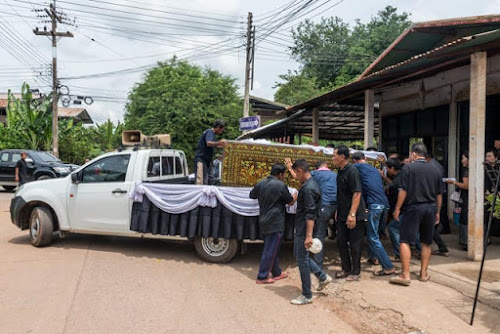
The procession slowly marched to the Wat inside of Nong Daeng Village with
the silence of procession occasionally interrupted by firing noisy
whirling fireworks high into the sky. To get to the Wat the procession
had to cross and walk along the main farm road. A couple of times,
tandem trucks were forced to
share the road with the procession. As the procession entered into the
Wat grounds a large firecracker was set off hopefully to scare the
spirits.

The funeral procession circled the
Wat's crematorium three times. Most of the people upon completing the
circumambulation of the crematorium entered the simple pavilion, bot, next to
the crematorium and sat upon sahts (colorful woven reed mats) placed on
the tiled floor. Other people sat outside in the rows of plastic chairs
that had been set up outside of the bot. Some of the village men removed
the refrigerated coffin from the truck and carefully placed it on the
concrete slab in front of the crematorium. It was opened and the simple
white coffin was removed and carried up the stairs to the doors of the
furnace. The coffin was placed upon two metal sawhorses. Some other men
then unloaded the man’s personal possessions and placed them alongside
of the crematorium on the ground to be burned separately.
People then went into the simple temple where offerings were made to the seated Monks. Like the number three, nine is a very good
number in Buddhist beliefs. Nine Monks is considered to be a good number
for occasions such as weddings, house blessings, and funerals. During
the offering ceremony, young girls passed out small containers of
chilled soft drinks and water.
The offering ceremony appeared to be like
so many of the other ceremonies that I have attended for all kinds of
different reasons.
In observing the ritual, I did not see anyone that I would consider to
be a "professional" in these matters. There were no funeral director or
mortuary representatives. Once in awhile the local Monk provided a
little direction to the local men but for all intentions it appeared
that the lay people were handling the rites. I asked Duang about this
and found out that it was the villagers and family that handle the
funeral activities with guidance from the Monks.
There is no "big
company" involved in funerals. The family washes and prepares the body.
Villagers, friends, and neighbors pay their respects by handling other
activities. Once again I have witnessed a strong sense of community in
Isaan.
I am now well known about the village, family and surrounding area so I
was encouraged by many people to go about and photograph the ceremony.
The ritual at the bot, involved chanting by the Monks and the mourners. A Layman, who was a former Monk and experienced in spiritual as well as ritual matters lead the mourners. The conclusion of this part of the ritual involved family members making offerings of cash and daily goods to the attending Monks.
A man then started a narrative about the deceased man and his life. He concluded by individually calling out the names of attending dignitaries. The dignitaries are government officials and members of the Police forces. When their name is called the walk up and accept offerings of Monk's robes. After accepting the robes, they walk up the stairs to the closed coffin, pay their respects, and place the robe on top of the coffin. They respectfully stand on the other side of the coffin and await the arrival of a Senior Monk to make the offering of the robe to him.

After the offering of robes, the man calls out the names of family. Each person goes to the base of the crematorium to accept an offering of a towel or cloth meant to be offered to the Monks. After accepting the offering, the family member climbs the stairs to the coffin, pays their respects, places the offering on top the coffin, and returns to their seat. Once all the towels have been placed on top of the coffin, the Monks go up to the coffin and accept the offerings.
A man then read the names, and home villages of extended family members and selected mourners. As their name was read, they stood up,
walked over to the stairs of the crematorium, received a plain white envelope, climbed the stairs to the coffin and placed it on a metal tray atop the coffin. The money will later be offered it
to the Monks. In
making the offering, the family members earned merit for the deceased as
well as for themselves – thanks to the generosity of the deceased’s
immediate family.
After the envelopes of cash had been collected and returned to the family at the bot, the
remainder of the people including many children of all ages lined up at the foot of the stairs. At
the base of the stairway there were two large bowls with little packets
made out of bamboo strips and paper. people climbed the
stairs of the crematorium to place good luck tokens, "Daht Mi Jon" on
trays positioned on top of the closed coffin.

After the offering ritual of Daht Mi Jon was completed,
some men removed the lid on the coffin for the next part of the ritual. The Daht Mi Jon were placed inside of the coffin to be consumed by the flames.
A
nephew had prepared several green coconuts using a long knife to cut
off the tops to open up a small hole to exact the clear liquid inside.
The other end of the coconut had been cut square so that the coconuts be
stable when placed on the concrete slab next to the coffin.
All the Monks then climbed the stairs to the coffin for opening of the coffin. Men with sickles cut the strings that had secured a shroud around the body, as well as the strings that had trussed up the body prior to rigeur mortis setting in. The eldest son leaned over the coffin and, using his teeth, removed the handkerchief covering his father's face. The. Monks then commenced pouring coconut water on the corpse and said their final farewells.
By
now the family had appeared and climbed up the steps of the crematorium
to where the coffin rested. They started taking the coconuts and
emptying the contents on the corpse.
Duang has told me that everyone in Isaan has their face "washed" with
coconut liquid because everyone likes green coconut water and it cleans
the face. The purpose of the offerings is to nourish the spirit and
cleanse as well as cool the spirit for its upcoming journey.

Children witness and participate along with the community in the death
rituals of family, friends, and neighbors. Death is as much a life
milestone for the Lao Loum community as birth, Monk ordination, and
marriage. To a certain extent, while the ritual is solemn, respectful;
it was also a sort of celebration in the sense it recognized that life
is suffering and that the deceased person's suffering in this life had
ceased.
The daht mi jon were collected and placed on the corpse inside of the
coffin. A cane knife was used to punch drainage/ventilation holes
inside of the coffin. The holes allowed the coconut water to drain out
and to assist in the combustion when the coffin was placed in the oven.
The corpse was temporarily turned on its side so that coconut shells could be placed at the bottom of the coffin. The body was then turned back on its back supported by the coconut shells.
The coffin was then lifted off of the metal saw horses and placed upon a
bed of charcoal atop a metal wheeled carriage. The sides of the coffin
were doused with about two liters of hydrocarbon fluid - it was not
diesel, it smelled very strong but I suspect that it was not gasoline.
It might have been naphtha since when it was ignited it was not as
explosive as gasoline. The carriage was rolled into the oven, the doors
were closed and secured. A Monk took a burning decoration and placed
it inside of an ignition port on the oven door to start the cremation
fire.
As the fire started, a string of very firecrackers went off. The
fireworks were set off to scare away any bad spirits that were in the
area as the woman's spirit was released by the fire. I doubt any
spirits would hang around after such fusillade.
As the fireworks were going off, a couple of the relatives started
throwing handfuls of candy, coins, and other mementos from the
crematorium steps to the awaiting children and adults below. This act
represents the renunciation of material goods by the deceased persons
spirit as it commences it journey.
The Lao Loum funeral rituals
demonstrate the strong sense of family and community that helps to bind the
people together. The social fabric of Lao Loum culture is colorful and
tightly woven.
The entire service had lasted four hours.
This ritual was simple, touching, and very dignified. I was once again
very impressed with the sense of caring, sense of community and respect
exhibited by all the people. It was interesting as well as reassuring to
see how the people took care of each other with dignity and compassion.

 Posts
Posts


